GWS and the Coalface: Built On It, Or Just Married To It?
The Giants have owned the contested ball for the best part of a decade, and their good years keep arriving alongside it. But 2026 and 2025 both muddy the neat story — so we put the room on it.
GWS GIANTS sit 8-9 after 17 games in 2026, winning the contested-ball count 6th of 18 sides with a modest edge, yet stuck below the halfway line. Zoom out and the club has won the coalface count in eight of its last ten seasons, playing finals in seven of them. The popular line is that Giants footy is built on the contest. This room tests whether the coalface is the engine of their success — or a passenger that happens to travel with it.
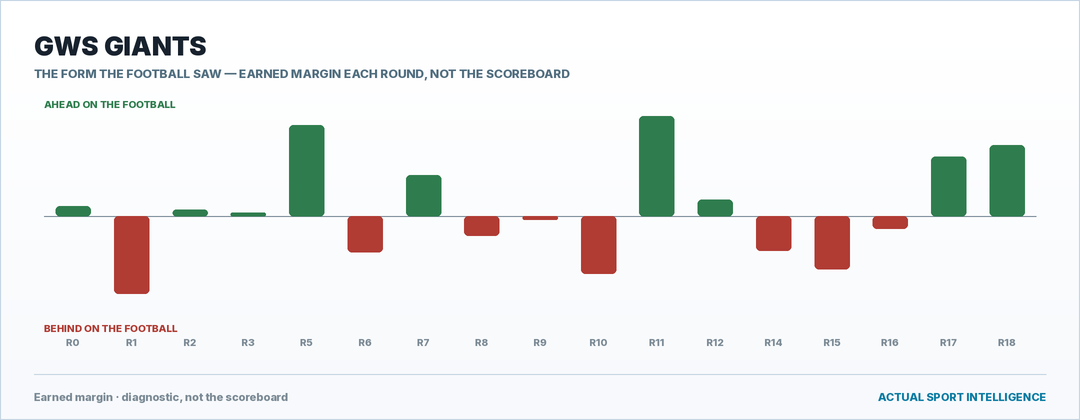
Watch GWS in 2026 and the contest is not where the game turns. At the coalface they and their opponents split things close to evenly — a slight edge, not a stranglehold. Where the football actually opens up is when they move it at will through the middle third and hit the scoreboard harder than their chances deserve.
That's the tell. This is a side whose identity lives in transition and clean conversion, not in bullying the stoppage. Their soft spot is the opposite side of the ball — disrupting the opposition's flow — which is a pressure-and-turnover problem, not a hardness-at-the-contest problem.
So the football on show says the contest is a foundation they stand on, not the weapon that wins them games. When they're good, it's the ball use.
The historical pattern is genuine, not noise. Across ten seasons GWS have won the contested-ball count eight times, and played finals in seven of them. That's a strong companionship between the coalface and the ladder.
But companionship isn't cause. 2025 is the awkward data point: they ranked 14th of 18 at the contest, losing it by a couple of possessions a game, and still finished 7th. This season flips it the other way — they're winning the contest 6th of 18 and sitting 8-9. Two straight years where the neat rule doesn't hold.
So I'd say this with confidence: GWS usually win the contest, and their better years usually feature it. What the evidence cannot say is that the contest drives the success — the most recent seasons actively argue against a clean cause-and-effect.
For most clubs, owning the contested ball eight years in ten would be remarkable. For GWS it's practically the house style. So the question isn't whether they win it — they usually do — it's whether winning it lifts them to where they want to be.
The archive says: not reliably. Their strongest contest season, 2019, ranked them 2nd in the league at the coalface — and they finished 6th. Their worst, 2022, they dropped to 14th and bottomed out at 16th. The extremes line up loosely, but the middle is messy.
Measured against a genuine finals standard, contest supremacy has been necessary furniture rather than the thing that separates a good GWS season from a great one. It feels like the story because it's ever-present, not because it's decisive.
This is where I have to be honest about what's in front of me. The contest is not won by a team average; it's won by specific bodies — the mids who crack in, the ruck who hits it to advantage, the forwards who lay the tackle that forces the ball back to ground. The evidence here holds the team totals, not the individuals behind them.
So I can't tell you whether GWS's coalface record rests on two or three elite contest-winners or a broad, even workload — and that distinction changes the whole story. A contest built on a small group is fragile; one built across a list is a genuine identity.
Without that layer, anyone claiming the club's success is 'built on' the contest is describing a scoreboard-level trend and calling it a player-level truth.
Here's the outcome-bias trap. The 'built on the contest' line survives because we mostly remember the good GWS years, and in those years the contest was there too. It's easy to backfill the coalface as the reason.
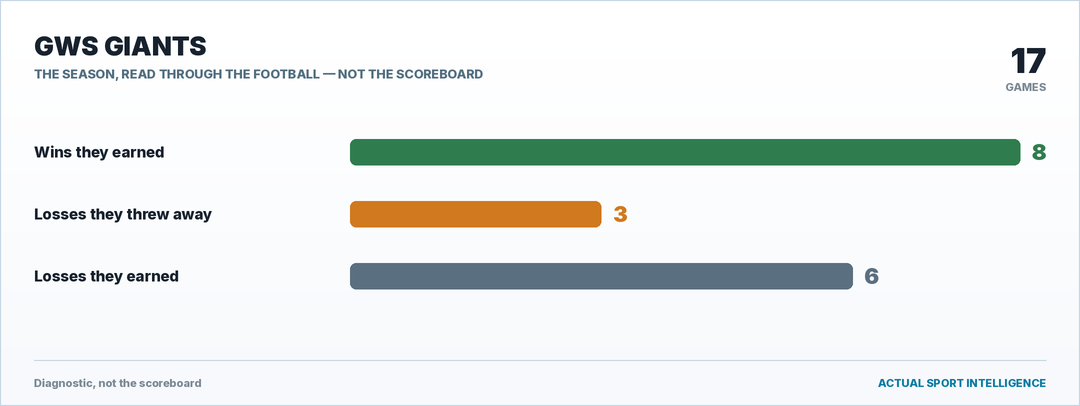
But look at 2026 with the result covered up. They're winning the contested ball comfortably enough to sit 6th of 18 — and the record is 8-9. Of those nine losses, six were fair beatings and only three were games they let slip. That's not a side being betrayed by bad luck at the coalface; it's a side winning the contest and still not converting it into a winning season.
If they'd finished 4th, we'd be toasting the contest as the foundation. Same coalface numbers, worse ladder position — and suddenly the contest isn't the headline. That's the scoreboard writing the analysis.
Let me put the case that dismantles the room's comfortable version. If GWS success were built on winning the contested ball, then losing the contest should cost them and winning it should reward them. Neither held recently.
2025: they lost the coalface count clearly — 14th of 18 — and still played finals in 7th. That is a season of success built on something other than the contest. 2026: they're winning the coalface and languishing at 8-9. Two consecutive seasons where the supposed foundation and the outcome point in opposite directions.
Add the club's own identity — best work moving the ball, weakest work disrupting the opposition — and the contest looks like a habit, not a cause. The honest challenge to anyone selling the contest theory: your own most recent evidence says the Giants succeed when they move and finish, and struggle when they can't stop the opposition, contest edge or not.
Put the six reads together and the shape is clear. Nobody disputes that GWS win the contest — they've done it eight years in ten. The argument is about the word 'built'. Built implies the contest is load-bearing: remove it and the house falls.
But the recent evidence shows the opposite. In 2025 they succeeded without the contest. In 2026 they own the contest and haven't succeeded. Their season identity points elsewhere entirely — they hurt sides by moving the ball at will and finishing more clinically than their chances warrant, and they slip when they can't disrupt the opposition.
So the real story isn't 'contest equals success'. It's a club that has quietly changed what wins it games. The coalface is the family heirloom — always in the room, deeply part of the identity. The engine is now in transition and conversion. The headline shouldn't be about hardness; it should be about ball use.
What the room agrees on
The room agrees on the core facts: GWS have won the contested ball in eight of their last ten seasons and played finals in seven of those, so the contest is genuinely woven into the club's identity. Everyone also accepts the loose long-run link — their strongest contest years and stronger finishes tend to keep company. Nobody is arguing the Giants are soft at the coalface.
Where the room still has tension
The tension is over the word 'built'. Hartley, Marsh and Chen point to the two most recent seasons pulling in opposite directions — 2025's finals run while losing the contest, 2026's contest edge stuck at 8-9 — and argue the real engine is ball movement and clinical finishing. Nair holds that the decade-long pattern is real even if it isn't causal. Morrison flags that without player-level detail, nobody can say whose contest work matters. Webb warns the whole 'built on' story may just be the scoreboard talking. That disagreement is the point, not a flaw.
What the evidence carries
What survives the whole review is this: GWS almost always win the contested ball, and that habit is a real part of who they are. What does not survive is the claim that their success is built on it. The two most recent seasons both break the clean link — one succeeding without the contest, one winning the contest without succeeding.
The club's own fingerprint points elsewhere: they do their best work moving the ball at will and converting better than their chances deserve, and they slip when they can't disrupt the opposition. On that reading the coalface is a foundation they stand on, not the weapon that wins games.
What the evidence can't close is the player layer — whether a handful of bulls or a whole list drive the contest — and that would sharpen the picture considerably. The contest is present, honoured, and real; whether it's the cause of GWS success or a passenger riding alongside it is the call, and the rest is yours to weigh.
Why it matters — How you answer this changes what you actually watch GWS for — the hardness at the stoppage, or the way they move and finish.