GWS Had This By More Than The Scoreboard Let On
The Giants beat Geelong by 13 in Round 18. The football says the gap was closer to 33 — and the way each side used the ball tells the real tale.
GWS Giants 86 defeated Geelong Cats 73 in Round 18, 2026. It reads as a tight home win, but the underlying football and the finishing on each side pull the story in a more interesting direction. Seven seats, one call handed back to you.
This wasn't a coin-flip win dressed up by a late goal. GWS owned the coalface, winning roughly eleven of every twenty contested balls, and they edged the territory battle and the metres gained almost stride for stride. When you win the hard ball and shade the ground, you're usually dictating terms, and GWS were.
What muddies the picture is finishing. GWS created the better looks — the quality of their chances was worth close to 99 — yet they walked off with 86. That's a side leaving goals out on the ground. Geelong, by contrast, squeezed every drop from less. The football story is a comfortable Giants performance; the scoreboard just didn't reward it in full.
With a single game you always hold your nerve on grand claims. What steadies this one is agreement across independent measures: contest, metres, entries and chance quality all tilt to GWS, and none contradicts the others. When separate signals line up, the reading is sturdier than any one number alone.
The cleanest marker is the gap between what happened and what it was worth. The scoreboard said GWS by 13; the quality of the football had them by about 33. That 20-point spread is finishing noise, not contest noise. So the honest position is this: we can say with reasonable confidence GWS were the better side on the day, and with equal honesty that they made it harder than it needed to be.
Set against the standard, this doesn't stand out as a freak result. GWS's ledger this year reads eight wins they earned, six losses they earned, three they threw away — and not a single win they got away with. This performance drops neatly into that pattern: a side that tends to deserve what it gets, for better and worse.
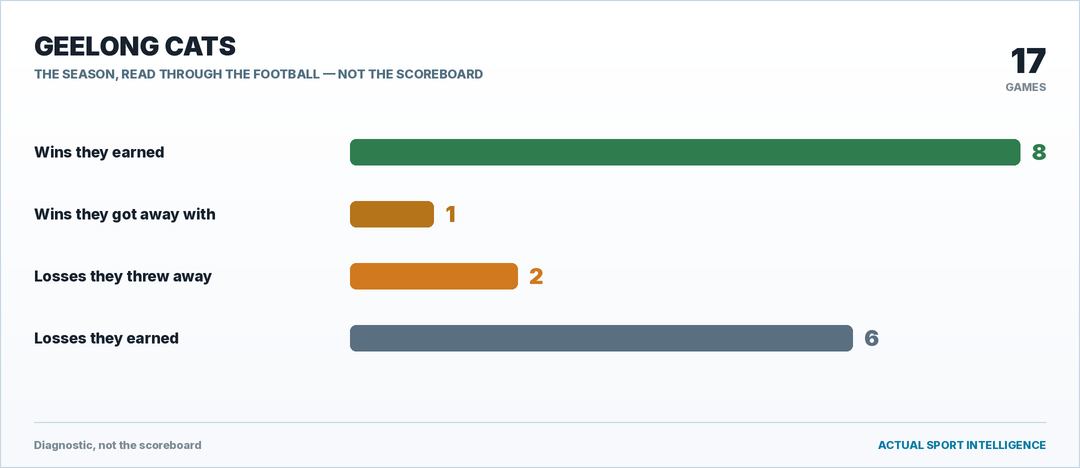
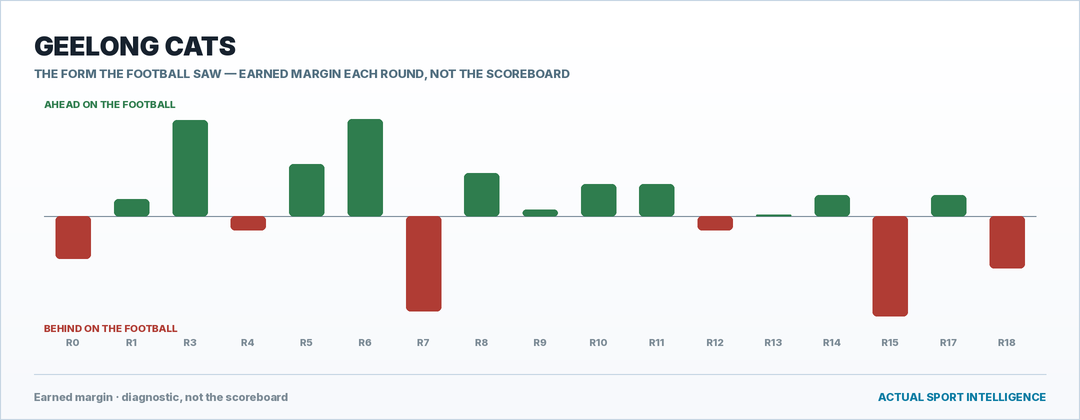
Geelong's season carries a similar honesty — eight earned wins, one they got away with, and a habit of moving the ball at will while slipping when asked to disrupt. That's exactly how this game ran: the Cats found space but couldn't choke GWS's ball movement. So the outcome isn't unusual. It's two sides behaving the way their whole year says they behave.
The engine flags Clayton Oliver, Lachie Ash and Toby Greene as the most decisive Giants — and that trio maps onto how the game was won. Oliver at the coalface where GWS controlled the contest, Ash carrying and linking through the corridor where the metres piled up, Greene giving the forward half a threat that stretched Geelong.
For the Cats, Bailey Smith and Shaun Mannagh were the best of them, and that matters: they were the reason Geelong's finishing outstripped their chances. But being the best two on the losing side is a different thing to changing the result. They kept the margin to 13 rather than the 33 the football pointed to. Real contributions — just not story-changing ones.
This is the test that catches a lot of match reports out. Imagine Geelong had nicked it by a kick on the back of their clinical finishing. The story would've been written as a Cats win, a gutsy road result. But the contest, the territory, the metres and the chance quality wouldn't have moved an inch — they'd still all favour GWS.
That's the tell. The Giants' case here doesn't lean on the scoreboard; it survives the scoreboard going the other way. Geelong's finishing was the thing keeping them in it, and finishing is the most fragile part of any performance to build a reputation on. Strip the outcome away and the underlying game is unchanged: GWS the better side, flattered downward by their own wastefulness.
Here's what genuinely tests the room's line. Chance quality measures the look, not the finish — and football is decided by finishes. GWS created 99 worth of chances and banked 86. That 13-point leak isn't bad luck to be dismissed; on another day, against a side finishing as cleanly as Geelong did here, it's the difference between winning and losing.
And Geelong were clinical — 73 from looks worth 66. That's a side that knows how to make a smaller share of the ball count. If you're building the case that GWS were comfortably better, you have to reckon with the fact that they nearly weren't comfortable at all, and that the trait keeping them ahead — dominance without conversion — is exactly the trait that gets punished. The dominance was real. So was the fragility.
Beneath the tidy home win sits a clean argument. This was two sides playing to type: GWS the more dominant, Geelong the more efficient. The Giants won more of everything that builds a game and converted less of it. The Cats won less and made more of it. The 13-point margin is the exact meeting point of those two truths.
The headline should read GWS deserved this — and they did, on every measure of control. But the sharper story is the one hiding in their own numbers: a season-long clinical side had an off day in front of goal and got away with it because their base was strong enough to carry them. The contradiction is that the winning trait and the worrying trait sat in the same performance.
What the room agrees on
The room is broadly settled that GWS controlled this match. They won the contest, edged the territory and metres, and created the better looks — the football had them ahead by about 33 while the scoreboard said 13. That gap is a finishing gap, not a contest gap, and every seat accepts the underlying game favoured the Giants. It's an earned win that fits their season, where eight of their wins have been deserved and none flattering.
Where the room still has tension
The tension is over what the finishing means. One side of the room treats GWS's wastefulness as noise — a good side leaving goals out that doesn't change who was better. The other side, led by the counter-case, insists it's a real flaw: dominate without converting and a clinical opponent — exactly what Geelong were here — can make you pay. Both are looking at the same 13-point leak and reading its weight differently.
What the evidence carries
What survives all seven seats is this: GWS were the better team, and it isn't close on the underlying football. Contest, ground, entries and chance quality all point one way, and the win matches the pattern of their whole year.
What also survives is the caveat — they won the game they should have won by less than they should have. Geelong's efficiency, driven by Smith and Mannagh, kept a 33-point football performance to a 13-point scoreboard. That's a genuine wrinkle, not a footnote.
So you're left with a dominant side that didn't cash in, and an outclassed side that nearly did. Whether you file that as a comfortable win with a flaw, or a warning dressed as a win, the rest is yours to weigh.
Why it matters — It's the difference between reading GWS as a side that controls games and one that leaves the door ajar — and this match holds both.