Essendon And The Hard Ball: The Story The Contest Count Won't Tell
Has the Bombers' best football ever really been built at the coalface? 2026 makes the question sharper, not simpler.
The idea that Essendon's success rides on winning the contested ball is a tidy one — the sort of line that sounds like footy law. But at 1-16 in 2026, 'success' is the wrong tense, and the club's own decade tells a stranger story: their finals seasons and their contest seasons barely overlap. The room takes the claim apart.
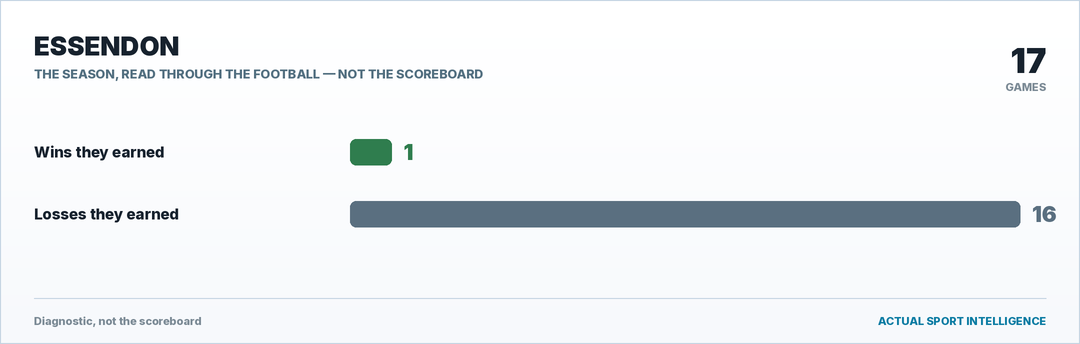
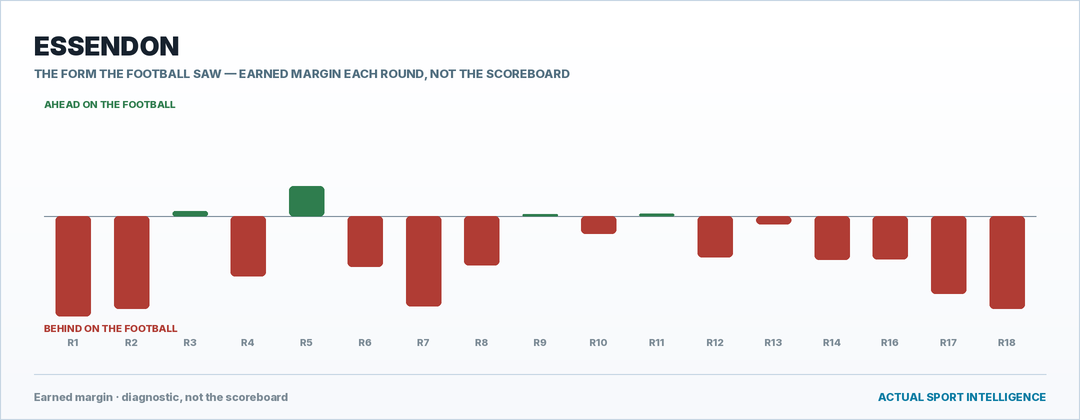
Watch how this Essendon side wants to play and the contest isn't the engine. The football's read on their season is clear enough — where they do their best work is moving the ball at will, and where they come unstuck is disrupting the opposition. That's a side built to flow, not to grind.
The hard-ball numbers back the eye. This year they're being edged at the contest, sitting 14th of 18 and losing that count by about five a game. A side that lived on contested ball wouldn't sit there. Their identity is forward of the ball and in transition, not in the trenches.
So the football on show doesn't describe a contest-first team having a bad year at the contest. It describes a team whose plan was never really about the contest at all.
Let's be precise about what the evidence carries. Since 2017, Essendon have won the contested-ball count in 3 of their last 10 seasons, and played finals in 3 of those 10. The catch: they won the contested ball in only one of the seasons they reached finals.
That's the number that breaks the tidy story. If success were built on the hard ball, the finals years and the contest-winning years would line up. They don't. In 2019 they finished 8th while ranking 13th of 18 at the contest, losing it by nearly five a game.
This season sits in the same family — 14th at the contest, down five a game, and 1-16. So across a decade the contested ball tracks neither strongly with finals nor cleanly with this year's collapse. On the direct question, the correlation the claim needs simply isn't there.
Set this against a proper baseline and the romance fades. Their strongest contested-ball season in the last decade was 2018 — plus a couple of possessions a game, 6th in the league — and they finished 11th. That's the ceiling: a top-six contest year that still missed finals.
Their floor was 2020, dead last-but-three at the contest, down nearly seven a game, finishing 13th. So the spread runs from 6th to 15th at the contest, and the ladder barely moves with it. Finals sides typically hang their season on something repeatable and elite; Essendon's contest work has never been that lever.
Against the standard that actually wins football, winning the hard ball has been, for this club, a nice-to-have — present in good years and bad, decisive in neither. It feels significant only because the contest always sounds significant.
If you're hunting for what genuinely shifts Essendon's fortunes, the contest isn't where the fingerprints are. The standout trait across the year is that they've been clinical — they convert better than the raw quality of their chances suggests. That's a scoreboard skill, not a coalface one.
That matters because it points to who's carrying the football when it counts: the players finishing chances and moving the ball, not the ones purely winning it back. A side losing the contest by five a game and still built on 'winning it at will' in transition is a side whose value lives forward of the contest.
So the headline names the wrong hero. The contest-winners aren't the ones dragging this club's better football out — the ball-users and the finishers are. The hard-ball merchants have been along for the ride, not steering it.
Start with the obvious contamination: the topic assumes success, and the scoreboard says 1-16 from 17. So we're asked what a good run is built on while the club is having a terrible one. That framing invites us to reach backwards for a comforting explanation.
Here's the test. Would we credit the contested ball if we flipped a result? Take 2019 — finals, 8th, but 13th at the contest and down nearly five a game. Nobody watching that season would have called it a contest-driven year, yet the ladder position tempts us to backfill a hard-ball narrative that the numbers refuse.
Outcome bias runs both ways here. Good ladder finishes make us hunt for a gritty cause; a 1-16 year makes us blame lost contests. Strip the scoreboard emotion out and the contest count sits roughly where it always sits — mid-to-low — regardless of how the season ended.
Let me press the other way, because the room is close to waving the contest off entirely. This season Essendon are 14th of 18 at the contest, losing it by five a game — and they've won one match. That pairing deserves respect, not a shrug.
You can argue the contest isn't their identity and still argue it's a floor they've fallen through. A side that moves the ball 'at will' still needs the ball; get beaten at the source badly enough and the flow never starts. The 2019 counter-example is real, but one finals year built despite a contest deficit is a thin plank to stand a whole theory on.
So the honest challenge is this: 'not the foundation' can quietly become 'doesn't matter', and that's a step too far. The contest may not build Essendon's best football, but being smashed at it can still help unbuild their worst.
Beneath the topic is a mismatch of eras and definitions. The claim wants a neat mechanism — win the hard ball, win football. Essendon's decade tells a messier truth: they reached finals three times, won the contest three times, and lined those up just once.
That's the central contradiction. Their identity is built on moving the ball and finishing chances, not grinding at the coalface — so their success, when it came, arrived through a different door. The contested ball has been a passenger in both their good years and their grim ones, this 1-16 season included.
The headline shouldn't ask whether the contest built their success. It should ask why we keep expecting it to. This is a club whose best football has consistently come from somewhere else — and the counter-seat's warning holds: not being the foundation isn't the same as being harmless when it collapses.
What the room agrees on
The room lands together on the core point: across the last decade, Essendon's finals seasons and their contest-winning seasons barely overlap — they won the contested ball in only one of the three years they made finals, and made finals in 2019 while ranking 13th of 18 at the contest. Their identity is moving the ball and finishing chances, not grinding it out. On the direct question, the evidence doesn't support the idea that success is built on winning the hard ball.
Where the room still has tension
The tension is about what that absence means now. The counter-case insists that being beaten at the contest by roughly five a game, in a 1-16 season, is not harmless just because it isn't the identity — a flowing side still needs the ball. Others argue the scoreboard is contaminating the whole question, tempting us to backfill a hard-ball explanation onto ladder positions that were never contest-driven either way. 'Not the foundation' and 'doesn't matter' are not the same claim, and the room won't collapse them.
What the evidence carries
What survives all seven seats is this: the contested ball has never been Essendon's engine. In their strongest contest year, 2018, they finished 11th; in a finals year, 2019, they were near the bottom of the league at it. The hard ball has been present in good seasons and bad, decisive in neither.
What the evidence can't carry is the stronger claim that the contest is irrelevant. A side that lives on ball movement still has to win the ball first, and this year's contest deficit sits alongside a one-win season — related or coincidental, the numbers here can't fully separate.
So the tidy line — win the contest, win football — doesn't fit this club. Their success, when it came, walked through a different door. Whether their collapse this year walked through the contest one is the part the evidence leaves open, and the rest is yours to weigh.
Why it matters — Get the engine wrong and you rebuild the wrong part of a struggling club — and Essendon's decade says the coalface was never where their football lived.