The Four Points Say Collingwood. The Football Says Hold On.
Collingwood walked off Round 18 with the win and the write-up. The underlying game had North Melbourne a whisker in front — so what actually happened out there?
Round 18, 2026: Collingwood 89 defeated North Melbourne 85. A four-point win on the ladder, but the engine's read on the quality of the football tells a quieter, more awkward story — and the room went looking for it.
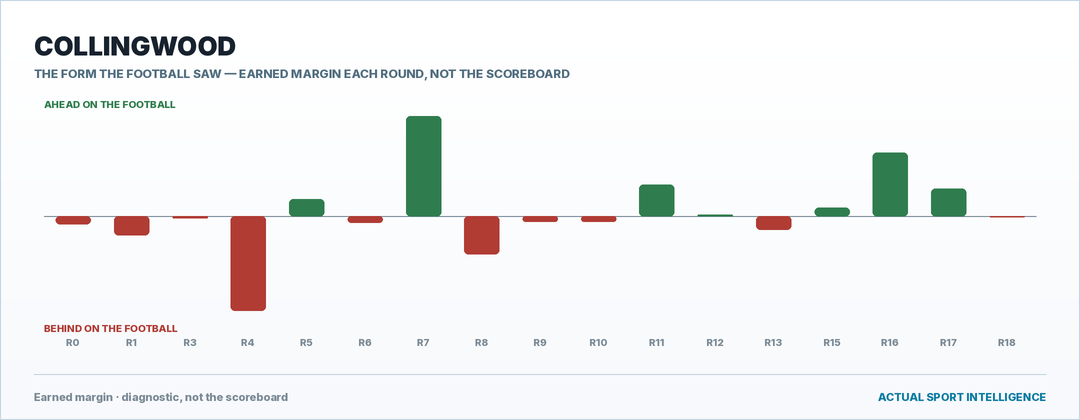
This was a game decided in the margins, not by a side taking control. The contested ball went North Melbourne's way, territory was split almost down the middle, and both teams carried the ball roughly the same distance up the ground. On the raw picture, nothing separated them.
Where Collingwood stood out was pressure — they laid tackles at a much heavier rate, close to forty per cent more than North. That's a genuine feature, not an accident. But heavy tackling didn't translate into territory or scoreboard control, which tells you the Magpies were often chasing rather than dictating.
The telling part is what the chances were worth. Both sides were wasteful in front of goal — Collingwood's looks were worth a touch more than they scored, North's a touch more again. On the quality of the football created, North edged it. The scoreboard didn't follow.
Start with the size of the gap. Collingwood won by four points. On the quality of the chances, North Melbourne came out about one point ahead. Both of those margins are tiny — the kind of separation that lives inside the noise of a single game.
So the honest statistical position is narrow. The evidence supports "this was essentially even, and the four points went the way the football didn't quite earn." It does not support "North Melbourne were robbed" or "Collingwood were fraudulent." Those are bigger claims than a one-point underlying edge can carry.
The reliable signal is the wastefulness. Both sides scored below what their looks were worth — Collingwood 89 from about 95, North 85 from about 96. That's a shared finishing problem on the day, not a story about one side's superiority.
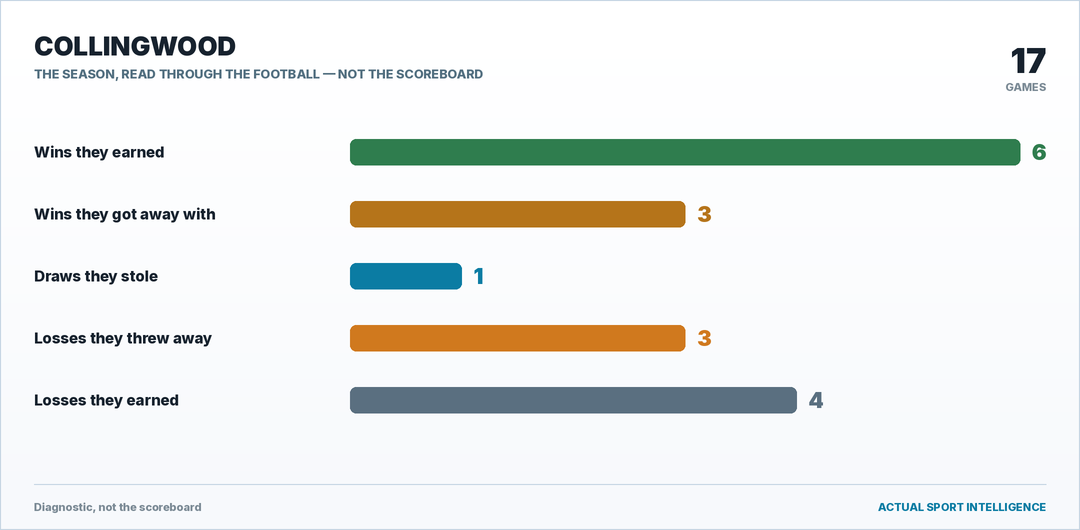
Put the game inside the season and it stops feeling like a one-off. Collingwood have already banked three wins this year the football says they got away with, plus a draw they effectively stole. This is a fourth entry in that ledger — flattering results are becoming part of who they are in 2026.
North Melbourne's archive tells the mirror story. Every one of their eight wins this year has been earned on the football — they don't flatter themselves. But they've also thrown away three losses. A tight game slipping through the fingers isn't new territory for them; it's a recurring pattern.
So neither the result nor the manner of it is unusual. It just feels fresh because it's this week. Both clubs behaved exactly as their season identities suggested they would.
The names that moved this game for Collingwood were Patrick Lipinski, Jordan De Goey and Josh Daicos. In a contest this even, midfield drivers who can turn scraps into forward-half territory carry outsized weight — and that trio did the tilting when the margins were thinnest.
For North, it was Nick Larkey and Tristan Xerri. Xerri's work around the contest fits North shading the contested ball, and Larkey up forward is the kind of target that keeps a wasteful attack breathing. In a game where North's looks were worth more than they scored, those two were the reason the looks existed at all.
The quiet truth: the players who changed the story for North still ended up on the losing side. Contribution and reward parted ways.
Here's the test that matters. If North Melbourne had kicked the last goal and won by four, would anyone be arguing? No. Given the contested ball, the near-even territory and North's looks being worth fractionally more, a North win would have read as "they got what the football deserved."
That's the outcome bias in plain sight. The exact same passage of play, with the scoreboard reversed, flips the entire narrative from "Collingwood found a way" to "North held on." When the story depends that heavily on which side kicked the final goal, the result is doing more work than the football.
Collingwood are being credited with a performance the numbers don't quite back. Strip the four points away and the praise loses its footing.
Careful before we hand North Melbourne a moral win. The underlying gap was about one point. That's not evidence of a superior side; that's a dead heat with a rounding error. Calling North the better team stretches a whisker into a story.
And Collingwood earned something concrete. Laying tackles at nearly forty per cent above North isn't luck — it's effort you can repeat, and applying that pressure in a tight game is a skill, not a fluke. Winning the close ones is part of the craft.
Don't forget North's own wastefulness. Their looks were worth more than they scored — they left points out there. A side that squanders its chances doesn't get to claim it was robbed. The four points went to the team that, for all the talk, converted enough to win.
Beneath the four points sits a contradiction. Collingwood's calling card this year is moving the ball at will; their weak point is control — actually holding a game in their grip. This match was that weak point in miniature: heavy pressure, plenty of ball movement, but no genuine grip, and a result better than the performance.
Stack it up and a pattern emerges. Four times now the Magpies have banked more than the football earned them. That's not a scandal — it's an identity. This is a side learning to win ugly, which is a real trait, but one that leaves the ledger looking healthier than the play.
North are the counterweight: they earn everything and still find ways to lose the tight ones. Two clubs, opposite relationships with their own results — and this game caught both in the act.
What the room agrees on
The room lands together on the shape of it: this was an even contest that the four points don't fully describe. Both sides were wasteful in front of goal, the contested ball and territory were close, and on the quality of chances created North Melbourne shaded it. Collingwood's tackle pressure was genuine and heavy, but it didn't convert into control. And crucially, this outcome fits both clubs' seasons — Collingwood's habit of banking more than they earn, North's habit of earning plenty and still losing the tight ones.
Where the room still has tension
The tension is over how much to make of it. Priya and Helen hold the line that a one-point underlying edge is too small to crown anyone — this was a coin-flip, and Collingwood's repeatable pressure and North's own wasted looks complicate any "robbed" narrative. Webb and Chen push the other way: reverse the final goal and the whole story flips, which shows the result is carrying the praise. Both are right, and that's the point — the football was close enough that what you emphasise decides what you conclude.
What the evidence carries
What survives all seven seats is this: the game was essentially even, and the scoreboard tilted a fraction further Collingwood's way than the football did. That's not a robbery and it's not a fraud — it's a genuinely tight contest where the four points landed on the side the underlying numbers had marginally behind.
What the evidence can't carry is a clean claim that North were the better team. A one-point edge on chance quality, in a game both sides misfired in attack, is too fine to build a monument on. It's enough to say the result flatters Collingwood; it isn't enough to say North deserved to win.
So the honest picture is a Magpies side whose 2026 record is running slightly ahead of its football, and a North side doing the reverse. Which of those matters more to you — the result on the ladder or the game underneath it — is the rest, and it's yours to weigh.
Why it matters — How you read this game is really how you read a season: whether you trust the scoreboard or the football underneath it.