DAICOS, UNTAGGABLE?
At 22, Nick Daicos is the hardest player in the league to keep away from the football. The question isn't whether you can stop him getting it — you can't. It's whether the ball he gets always hurts you.
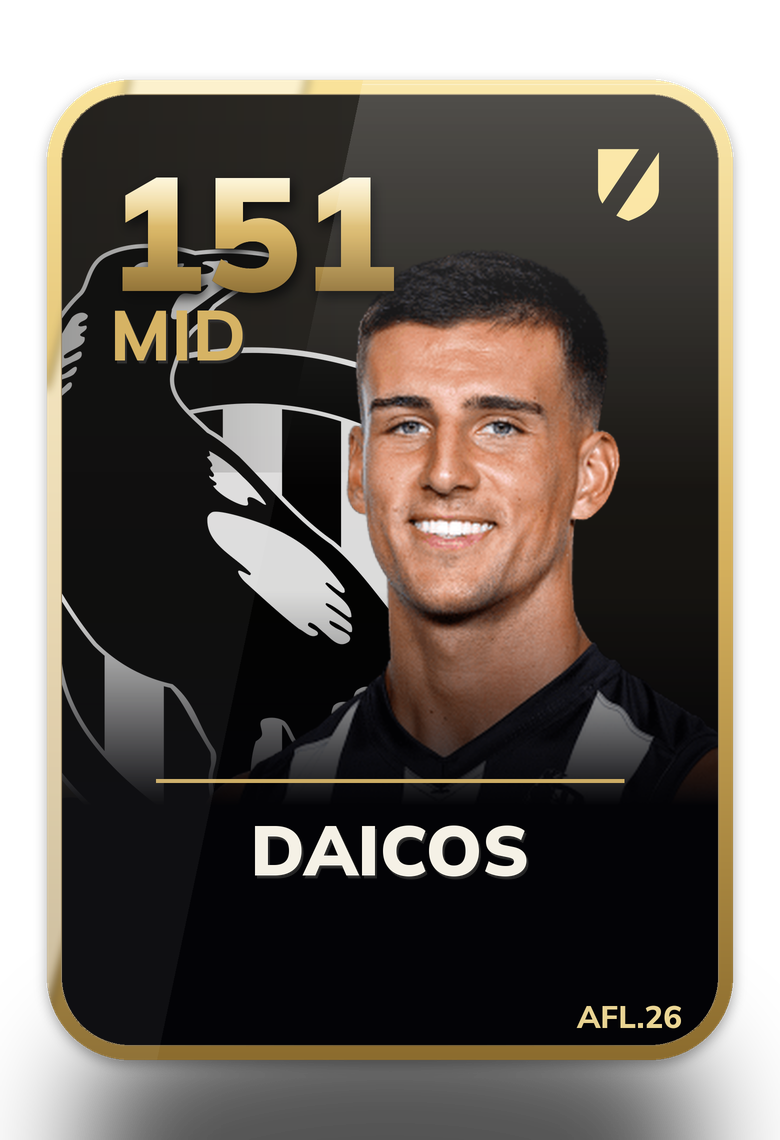
Untaggable — and it isn't close
Start with the shape of his year. His disposal floor is 28, his average is 35, and four times he has gone past 39. No run-with role and no zonal setup in the competition has knocked him below that floor — when a minder is sent, the shadow arrives late, on the mark rather than at the contest.
- The volume never breaks. Eighteen games, never fewer than 28 touches. Any "we shut Daicos down" claim that starts with "we held him to low numbers" falls over on sight.
- He stays central even on his quieter nights. His contribution rating — the plain measure of how much he adds to Collingwood's game — has sat above his own career baseline in every single game of 2026.
- So the fan line is true where fans mean it. You cannot stop Nick Daicos getting the football. That part of "untaggable" is real, and it's not close.
Involvement isn't impact
The cleaner way to read his season is to split it in two. Involvement — how often he touches it, how central he is — is untouchable. Impact — what those touches are worth, in territory and in scoreboard — is a different, more fragile thing.
Round 7 against Essendon is the picture. Daicos had 42 disposals — the most of any player on the ground — for one of his quietest impact ratings of the year. Scott Pendlebury, on a near-identical 43 touches the same afternoon, turned his into three to four times the rated impact. The touches were there. The damage was not.

You can't cut the hose. You can muddy the water.
Concede the volume, attack the quality
The sides that subdued him didn't sit a man in his pocket all day. They built a plan around a simple bet: Daicos will get the ball, so make sure the ball he gets is worth as little as possible.
In practice that meant congesting his contests, flooding the exit lanes he likes to use, pushing his ball backwards and sideways, and pressuring the moment of disposal so a clean kick becomes an ordinary one. His clean-ball rate on those nights fell into the 50s and low 60s, against the mid-to-high 70s on his best days.
Round 10 against Sydney is the sharpest example: his grip on the contest — usually the engine of his whole game — fell close to zero, while Sydney's pressure turned his touches into safe ones rather than sharp ones. The tag, in other words, happened at the point of decision, not the point of possession.
Midfielder or forward — the switch
The most useful cut of his year is where Collingwood line him up. As a pure on-baller and as a forward, his touch counts are almost identical — but the value of those touches is not.
As a forward he finds space — leads into the corridor, slips into pockets defenders have vacated — and his touches carry more danger. From Round 12 on, every game Collingwood have leaned him forward has landed high. Their answer to "how do you tag Nick Daicos?" is essentially "don't give you the angles to do it in the midfield."





The teams that blunted him share one trait: they are strong at contest and pressure. They were willing to over-invest at the source — extra bodies around Daicos and the first contest — run both ways to swarm his exit, and attack the receiver of his kick rather than Daicos himself. Sydney sit apart for choking his grip on the contest.
The message for a system coach is that to blunt Nick Daicos you commit a whole plan, not a single player. It is a second-order tag: not "follow Daicos", but "follow the play Daicos creates".
What suppression is — and isn't
One honest note for the record: his game is built on winning the ball and using it, not on winning it back defensively. So his quieter nights aren't a story of being beaten at the contest — he still gets there first. They're a story of the ball he wins being made safe before it can hurt you.
That is exactly why some coaches are willing to let him have it. Accept the first touch; constrain the outlet. It's a compliment dressed as a game plan — you only build a whole system around one 22-year-old if the alternative is worse.
If "untaggable" means "can't be kept from the ball," Nick Daicos has looked exactly that in 2026 — a stubborn floor, an unbroken run above his own baseline, and the ball found in traffic and space alike.
If it means "can't have his impact reduced," the season already shows the answer is no. The right opponent, with the right plan, at the right time, can turn a 40-touch night into a quiet one — not by emptying the stat line, but by hollowing out its value. The more Collingwood play him forward, the closer he gets to the full myth. The more he lives in midfield trench warfare, the more that Round 7–11 blueprint sits there to be borrowed.