Hawthorn's 11 wins, read line by line: force, or flattered by the ledger?
The Hawks sit 11-5-1 and the noise says contender. But the way those 11 wins were actually won tells a more honest story about how far this side really is.
Hawthorn have built a strong-looking 2026 record and the conversation has turned to whether they're a genuine top-tier side or a team whose ladder position runs ahead of its football. We put the season in front of the room: the raw record, the quality of each result, and the pattern underneath it.
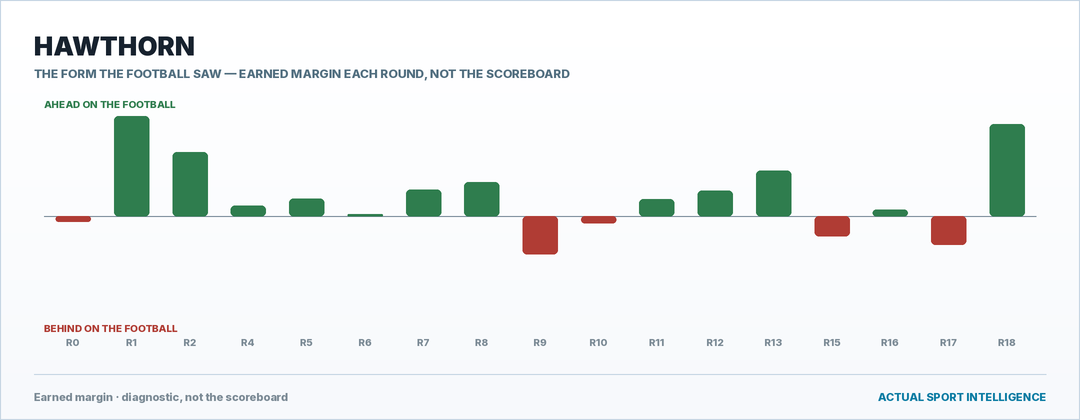
Watch Hawthorn and the eye goes straight to their ball movement. When they get it going, they move it at will — that's the part of their game that looks genuinely top-shelf, and it's why the 'force' talk exists. On their day they can carve a side open coast to coast.
The wobble is underneath that. Where they slip is control — the grunt work of winning the ball back and setting the terms of the contest. A side that scores off flow but doesn't dominate the source of the ball is living on a finer margin than the highlight reel suggests.
That's the football tension in one line: elite going forward, less certain at the coalface. Both things are true at once.
Start with what's solid. Eleven wins from 17 across a full run of games isn't a fluke of scheduling — it's a genuine body of work. So the floor here is a legitimately good season, not a mirage.
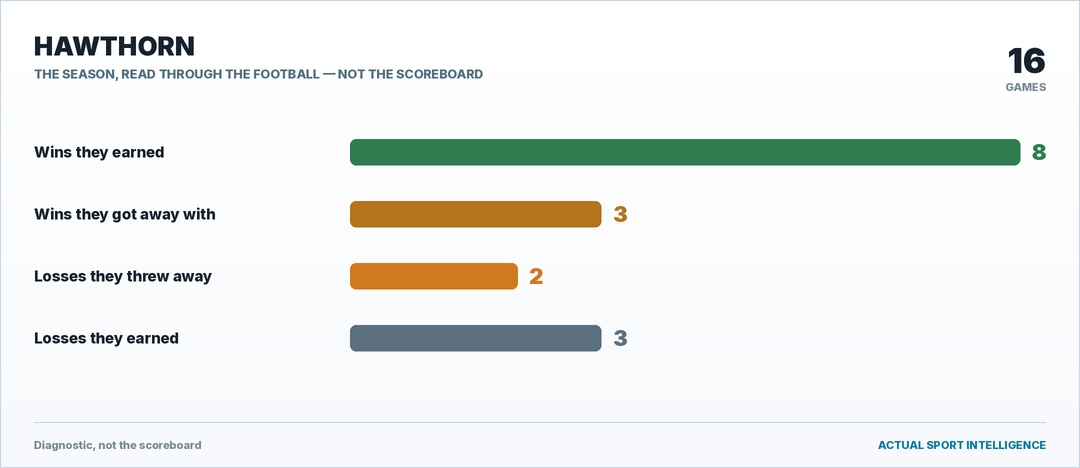
But the engine's read of those 17 games matters more than the tally. Eight of the wins were earned — Hawthorn were the better side. Three were wins they got away with, where the result flattered the performance. On the other side, two losses were thrown away and three were earned. So the honest count of clearly deserved results is eight wins and three losses.
That's a strong profile. It just isn't the profile of a side that's blown 2026 apart. The record says 11-5-1; the football says closer to a very good team than a dominant one.
Set this against the standard, not against last month's headlines. A side that earns eight of its wins outright is well clear of the pack of also-rans — that's real, and it should be said plainly.
But the winning standard is measured at the top, and there the questions sharpen. Sides that go deep tend to convert their chances and control the contest when it tightens. Getting three wins you 'got away with' isn't unusual for a good team having a good year — it's the ordinary texture of a season. The rarity you're looking for, the mark of a genuine force, is the ability to win the ugly ones without needing the football to fall your way.
So: unusual enough to respect, not yet unusual enough to crown.
There's no single hero to hang this season on in the evidence, and that's actually the point. What changes Hawthorn's games is the collective ball movement — the way the group moves it, not one match-winner dragging them home.
That's a healthier engine than a one-man show, because it doesn't rely on a single player firing. But it puts a spotlight elsewhere: the players tasked with control, the contest-winners who set the platform. When Hawthorn slip, it's that group being beaten to the source of the ball, and no amount of slick movement fixes a contest you've already lost.
So the honest player read is: the runners and movers are carrying the headline, and the contest workers are quietly deciding which version of Hawthorn turns up.
This is where the scoreboard plays tricks. Three of Hawthorn's wins were ones they got away with. Had a couple of those tightened the other way, the record reads differently and the 'genuine force' talk cools instantly — even though not one kick of the actual football would have changed.
Run it the other way too. Two of the losses were thrown away — games the football says they should have banked. Win those and suddenly the ledger looks even shinier than the performances deserve. Either way, the scoreboard is a noisy narrator here.
Strip the results out and you're left with a side whose underlying football is good and uneven in the same breath. The number 11 is doing a lot of persuading. The football is more measured than the win column.
Here's what could break the room's caution. Everyone's leaning on the three fortunate wins as evidence of a flattered record. But look at the other flag in the evidence: across the year Hawthorn have left points out on the ground — they've scored fewer than the quality of their chances was worth.
That cuts the other way. A side that creates better chances than it converts isn't papering over cracks — it's under-cashing a strong hand. If the football is generating that quality of opportunity, the process underneath the record may be better than 11-5-1 implies, not worse. The two thrown-away losses fit that same picture: good football, unrewarded.
Put those together and the 'padding the record' charge weakens. You can argue Hawthorn's real problem isn't that they've been lucky — it's that they haven't been paid in full.
Beneath the 'force or padding' framing sits a cleaner story. Hawthorn are a genuinely good ball-moving side who don't yet own the contest, and who don't cash in everything they create. Those two facts pull the season in opposite directions.
That's the contradiction. The wasted scoring says they're better than the results (the counter-case). The three fortunate wins and the soft control say the results are partly borrowed (the scoreboard read). Both can be true, because they're describing different parts of the same team — a strong front end sitting on an unfinished foundation.
So the headline shouldn't be 'force' or 'fraud'. It should be: a very good side with one honest gap between them and the top, and a record that happens to sit right in the middle of what they've earned.
What the room agrees on
The room agrees on the shape of it. Eleven wins from 17 is a real, good season, not a scheduling trick. The eight earned wins are the backbone and they're legitimate. Everyone also agrees on the identity: this side moves the ball at will and hurts you going forward, while control — winning the ball back, owning the contest — is the softer part of the game. And nobody disputes the two headline caveats in the evidence: three of the wins were flattered by the result, and across the year the Hawks have scored fewer points than their chances were worth.
Where the room still has tension
The tension is what those caveats mean. Webb reads the three fortunate wins as the record running ahead of the football — a side being talked up by its own scoreboard. Marsh flips it: a team that leaves points on the ground and throws away two winnable losses may be better than 11-5-1, not worse, because the chances it creates are stronger than the finishing. Cross sits between them — good enough to respect, not yet rare enough to crown. That disagreement isn't a flaw in the reading; it's the actual state of the team.
What the evidence carries
What survives all seven seats is this: Hawthorn are a genuinely good side with a genuinely good record, and the two things line up more than either the hype or the cynicism admits. The 11-5-1 isn't padding in the dishonest sense — eight wins were earned outright.
But it isn't a coronation either. The same evidence that says 'better than they're paid' (wasted scoring) also says 'not the finished article' (soft control, three borrowed wins). A genuine force wins the ugly, contested games without needing the football to fall its way. Hawthorn haven't yet proven they routinely do that.
So the choice in front of you is clean. If you weight the elite ball movement and the under-cashed chances, you see a top-tier side flying under its own record. If you weight the contest slippage and the fortunate wins, you see a very good team whose ceiling is unproven. The evidence carries both — the rest is yours to weigh.
Why it matters — How you read the gap between Hawthorn's ball movement and their contest work is how you decide whether this season is a launchpad or a level.