The Suns Don't Win the Rock — So Where's the Success Actually Coming From?
Gold Coast sit 7-10 and 12th for contested ball. If the story is 'built on the contest', the numbers are telling a different one. The evidence is in; the call is yours.
The claim under the microscope is a familiar one about Gold Coast: that whatever they're building rests on winning the hard ball. In 2026 they're 7-10 through 17 rounds, ranked 12th of 18 at the contest, and their own season identity points somewhere else entirely — to ball movement and clean conversion. This is a test of a popular framing against the ledger.
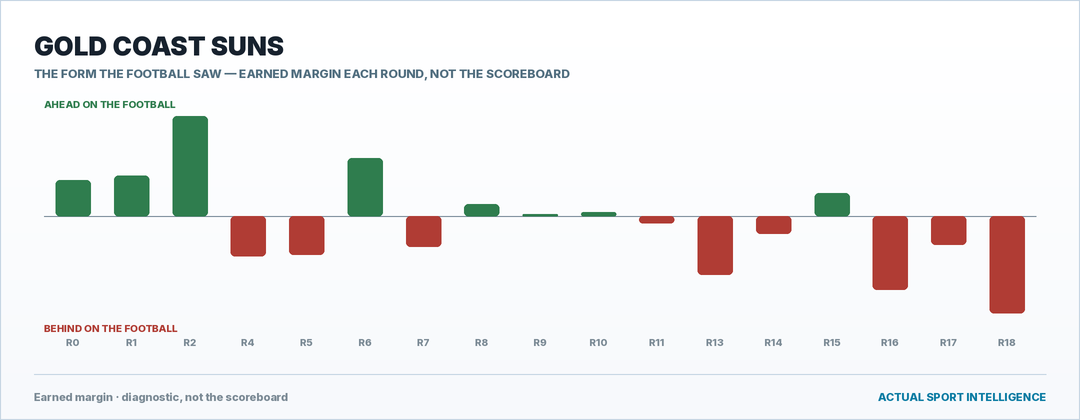
Watch Gold Coast this year and the damage comes from transition, not from the bottom of packs. Their season identity is clear: where they do their best work is moving the ball at will, and where they slip is when they have to disrupt the opposition. That's a running, linking, forward-half team — not a grind-it-out contested unit.
At the contest itself they're roughly line-ball, splitting the hard ball almost evenly with opponents across the year. That's not where the game is being won or lost for them. The mechanism that separates good Suns nights from bad ones sits further up the ground — how cleanly they go from win to score, and how much they let the opposition play through them.
So if you're looking for the engine, don't look at the ruck contest or the clearance huddle. Look at what happens after the ball spills.
Let's be precise. This season Gold Coast rank 12th of 18 at contested ball, on the wrong side of the ledger by a couple of possessions a game. That's not a strength; it's a shade below even. A team whose success is 'built on' something is usually top-tier at it. They aren't.
Stretch the lens and the pattern holds. Since 2017 they've actually won the contested-ball count in only 3 of 10 seasons. If winning the hard ball were the foundation, you'd expect the good years and the contest years to line up. Across the decade, they've moved largely independently.
What can we say with confidence? Their contested output this year is average-to-slightly-negative, and it isn't tracking their results. That's enough to say the 'contest' framing has outrun the numbers.
Put this against the club's own history and the romance fades. Their strongest year at the contest was 2025: they won the hard ball by a few possessions a game, ranked 6th in the league for it — and finished 6th. Good, not transformational. Winning the contest didn't launch them; it coincided with a solid, middling season.
Go the other way and it's the same lesson. Their worst contest year, 2018, they were dead last at the coalface and finished 17th — but 2020 tells the real story: 14th at the contest and 14th on the ladder, a season where losing the hard ball simply travelled alongside a poor year rather than causing a great one.
Against the winning standard, contested-ball dominance has never been the Suns' ticket. It just feels central because it's the easy thing to name.
The evidence points to a team that's clinical — they convert better than the raw quality of their chances suggests. That's a signature of decision-makers and finishers, the players who make a half-chance count, not the ones winning the initial hard ball.
So the honest player read is that whoever is being celebrated for 'winning it in tight' is probably carrying a headline the team profile doesn't earn. The genuine difference-makers are the ones who take an even contest and turn it into a scoreboard advantage through ball movement and accuracy in front of goal.
The engine can't name individuals here, and it shouldn't pretend to. But the shape is unambiguous: value is being added after the contest, not inside it.
This is the outcome-bias trap. On a good night, we'd point to a couple of tough clearances and say 'that's the Suns, built on the contest'. But the contested numbers are the same on nights they lose — they're 12th at it regardless of the scoreboard. The result is doing the storytelling.
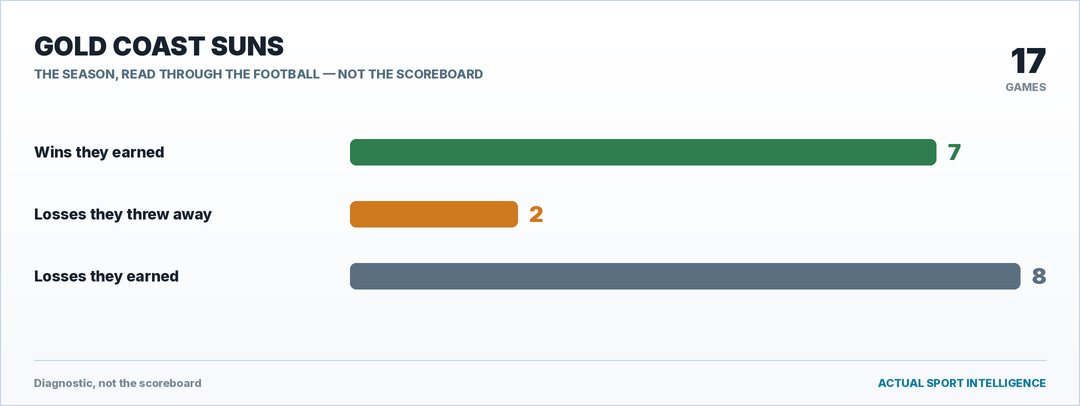
The football's own read of their 17 games is instructive: 7 wins they earned, 8 losses they earned, and 2 losses they threw away. That's mostly a team getting the result its performance deserved — and that performance is defined by ball movement and conversion, not by dominating the hard ball.
Would we believe 'built on the contest' if we ignored the wins and looked only at the method? No. The contest reading is a result-shaped memory, not a cause.
Here's what could rescue the claim. A team doesn't need to win the contest outright; it needs to not lose it badly. Sitting near even at the coalface may be exactly the platform that lets their ball movement and finishing do the damage. Get smashed in there — like 2018, when they were last and finished 17th — and no amount of clean transition saves you.
On that reading, 'winning the contested ball' is the wrong test. 'Surviving the contested ball' is the real foundation, and this year they're doing it. The contest still matters; it just matters as a floor, not a weapon.
It's a serious challenge. But note the ceiling: even in 2025, when they genuinely won the hard ball, it only bought a 6th-place season — so contest parity enabling the good stuff is plausible; contest dominance driving it is not.
Strip it back and the contradiction is clean. The popular framing says the contest. The evidence — season identity, decade-long history, this year's ranking — says ball movement and conversion, resting on a contest that's merely adequate.
The through-line is that Gold Coast's contested output and their results have travelled on separate roads for ten years. Their best finish coincided with their best contest year, which invites the causal story, but everything around it says coincidence and floor, not engine. The honest headline isn't 'built on the contest'. It's 'built on what they do once the contest is even'.
That reframing changes how you read every Suns performance. Stop watching the clearances for the answer. Watch what happens next.
What the room agrees on
Every seat lands in a similar place: this is not a contested-ball team by the numbers. They sit 12th of 18 at the hard ball this year, slightly on the wrong side of it, and across the last decade they've won the contested count in only 3 of 10 seasons with results that moved independently of it. The genuine strengths — moving the ball at will and converting better than their chances suggest — live after the contest, not inside it. The 'built on the contest' framing describes a reputation, not a mechanism.
Where the room still has tension
The live tension is what parity means. The counter-case argues persuasively that a near-even contest is the platform — you don't have to win the hard ball, you just can't get buried in it, and this year they aren't. On that view the contest is a genuine foundation, just a defensive one. The rest of the room reads it as a floor rather than a driver, pointing out that even their one strong contest year only produced a 6th-place season. Foundation or floor — the evidence leans one way but doesn't slam the door.
What the evidence carries
What survives the whole review is this: if 'success built on the contest' means dominating the hard ball, the numbers don't carry it. Gold Coast are mid-pack there, have been for most of a decade, and their good and bad years haven't tracked it. Their edge is transition and finishing.
What the evidence can't fully settle is the softer claim — that staying even at the contest is precisely what frees the rest of their game. That's a real, unresolved question, and it's the more interesting one.
So the honest position is that the contest is more likely their floor than their engine, and the engine is elsewhere. Whether you call an adequate contest a 'foundation' or just a prerequisite is the judgment the numbers hand back to you. The rest is yours to weigh.
Why it matters — How you name a team's engine decides which parts of their game you trust when it counts.