Geelong at 9-8: A Cliff, or Just a Cold Snap?
A proud side sits mid-table with the panic climbing. The room pulls apart what the football has actually shown from what the mood is telling everyone.
Geelong sit 9-8 after 17 rounds of 2026, and the noise is loud: is a proud side sliding to the edge, or is the alarm running ahead of the evidence? The room takes the same 17 games and reads them seven different ways.
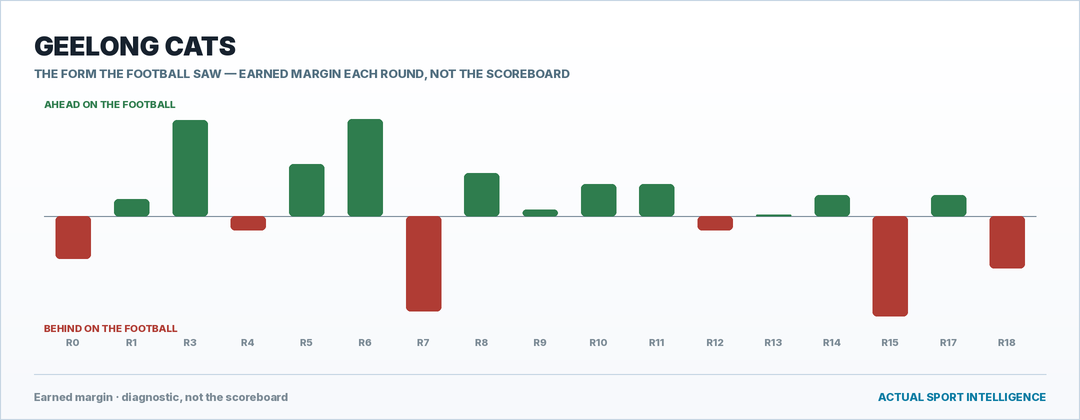
Watch the 17 games and one thing jumps out: when Geelong have the footy and space, they still hurt sides. Their best work all year has been moving the ball at will — chains that split the ground, cleanly finding forwards on the fly. That's not the profile of a team that's forgotten how to play.
The slip is on the other side of the contest. Where they leak is when the game asks them to disrupt — to choke the opposition's ball movement, to make the ground small when they don't have it. That's the difference between a side that's broken and a side that's lopsided. Right now Geelong are lopsided.
So the football shows a team with a live engine and a soft brake. That's a very different story from a cliff.
Seventeen games is enough to say something. This isn't a three-week wobble you can wave away. Geelong have played more than two-thirds of a home-and-away season and landed at 9-8. That's the evidence, and it's solid ground.
But solid ground cuts both ways. The same sample that denies you 'they're flying' also denies you 'they're falling off a cliff'. Nine wins and eight losses is the statistical definition of a side hovering around the middle — close to even, decided by margins.
What I can say with confidence: this is a team living on the line between good and ordinary, over a meaningful number of games. What I can't say is that the trend points down rather than sideways. The record describes where they are, not the direction of travel.
The panic is partly a Geelong-specific illusion. This is a club whose baseline for two decades has been September, not survival. Against that internal standard, 9-8 feels like the floor caving in.
Measured against the actual competition, it's far less dramatic. Nine wins from 17 is roughly the middle of the ladder — the standard of a side in the mix, not a side in freefall. It only reads as a fall because the reference point is Geelong's own unusually high shelf.
So the honest question isn't 'how far have they dropped?' It's 'compared to what?' Compared to a winning standard, 9-8 is short. Compared to the league norm, it's unremarkable. The freshness of Geelong being ordinary is doing a lot of the emotional work here.
When a side is genuinely sliding, you can usually name the player who's carrying the decline — the one whose drop-off you can see. Geelong's problem isn't that shape. Their finishing has roughly matched the quality of chances they create, which tells you the forwards aren't the culprits fluffing gettable shots.
The weakness is collective. Disrupting the opposition — stopping ball movement, applying the squeeze without the footy — is a whole-of-team job, not a one-man role. You can't point at a single name and say 'him'. That's why the headline reaches for the coach or the era rather than a player.
The hidden truth: the ball-movement engine is being fed by contributors doing their jobs. The failure sits in a shared responsibility that doesn't show up in one player's numbers.
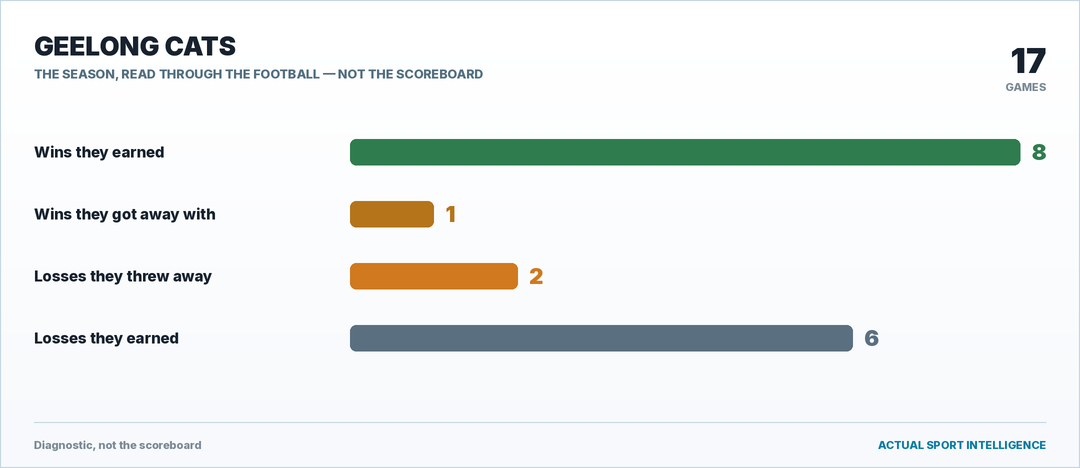
Here's the test that matters: would we be talking cliff if a couple of results had flipped? The football's own reading says Geelong threw away two losses — games they had a hand in losing rather than being beaten in. It also says one of their wins was fortunate, a game they got away with.
Run the honest version. Eight of their wins were earned outright. Six of their losses were earned by the opposition — beaten fair and square. The margins on either side are thin. If those two thrown-away losses go the other way, the mood flips from 'cliff' to 'quietly fine' overnight, on essentially the same football.
That's scoreboard contamination. The record is doing the storytelling, and the record was decided in the last few minutes of tight games. The performances underneath moved less than the narrative did.
Let me break the comfortable version. The soothing read is 'lopsided, not broken, just unlucky in tight ones'. But a defect you can name and haven't fixed over 17 games isn't bad luck — it's a habit. Geelong slip when they have to disrupt, and they've slipped there all year. That's a persistent, diagnosed flaw, not a run of close calls.
And 'threw away two losses' is not only exoneration. A side that repeatedly can't close is telling you something real about itself under pressure. You don't get to bank the fortunate win as skill and write off the thrown-away losses as noise.
For a club whose whole identity is contending, hovering at 9-8 while the standard climbs isn't neutral. Standing still can be its own kind of sliding.
Put the six reads together and the shape is clear. Geelong still have a genuine strength — they move the ball as well as anyone. They have a genuine, unfixed weakness — they can't reliably disrupt. And they sit at 9-8, which is honestly the middle, decided in the margins of tight games.
The contradiction the headline is chasing is this: the football says 'lopsided but live', while the emotion says 'cliff'. Both are responding to the same fact — a club with elite standards has landed on ordinary ground.
So the headline shouldn't be 'sliding to the edge'. It should be 'a contender confronting averageness'. The panic isn't measuring a fall. It's measuring the gap between what Geelong expect of themselves and what they've actually produced across 17 games.
What the room agrees on
Every seat lands on the same football: Geelong can still move the ball at will, and they slip when the game asks them to disrupt. The 9-8 record is a real, meaningful sample — big enough to trust — and it puts them squarely in the middle of the competition. The finishing has matched the chances, so this isn't a forward line misfiring. The room agrees the flaw is real, named, and shared across the side rather than pinned to one player.
Where the room still has tension
The tension is over what 9-8 means. Webb and Cross see a mood inflamed by outcome bias and by Geelong's own high shelf — thin margins in two thrown-away losses doing the heavy lifting on the narrative. Marsh pushes back hard: a weakness that's gone unfixed for 17 games is a habit, not bad luck, and for a contender, standing still while the standard rises is its own quiet slide. Nair holds the middle — the sample says 'even', not 'downward'.
What the evidence carries
What survives the whole review is this. The football is lopsided, not broken: a live ball-movement engine bolted to a soft brake, and that brake has stayed soft all year. The record is genuinely mid-table over a genuine sample. And the loudest word in the debate — 'cliff' — is the least supported by what the football actually shows.
But the counter-case earns its seat. A diagnosed, persistent weakness that hasn't been addressed across two-thirds of a season is not something to wave away as tight-game misfortune. Whether you call that 'sliding' depends on whether you think a contender treading water is already going backwards.
What the evidence carries: a club that's become average, with one clear strength and one clear unfixed flaw. What it can't settle: which direction the next stretch runs, because 9-8 points sideways, not down. The rest is yours to weigh.
Why it matters — It separates what the football has already proven — a lopsided, mid-table side — from the argument everyone's actually having about where it's heading.